Start by separating supply from treatment
Water preparation has two questions that are easy to combine incorrectly. Do you have enough water you can access? And is that water safe for its intended use? A powerful treatment device does not solve an empty container. A full tank does not prove its contents are safe. Begin by listing drinking, cooking, medicines, infant feeding, pets, and the household's hygiene needs. Record which uses require drinking quality water and ask your local health authority about any situation you do not understand.
Unopened commercially bottled water is CDC's most reliable emergency supply option. Its US planning baseline is at least one US gallon, about 3.8 litres, per person per day for three days; it suggests building a two week supply if possible. Heat, illness, pregnancy, and other circumstances can increase requirements. This baseline is not a universal personal hydration prescription or a complete allowance for every household task. Use local guidance and individual care advice when adapting it. Source: official source ↗.
Make the reserve usable by the people who live there
For a household of four, the three day US baseline is twelve US gallons, roughly 45 litres, before additional needs. That amount is heavy. Rather than buy a single container nobody can lift, think about where water will sit and how it will reach a cup. A small bottle on an accessible shelf and a larger reserve in a safe storage area can serve different purposes. Do not assume the person doing the planning will be present to lift, open, or dispense every container.
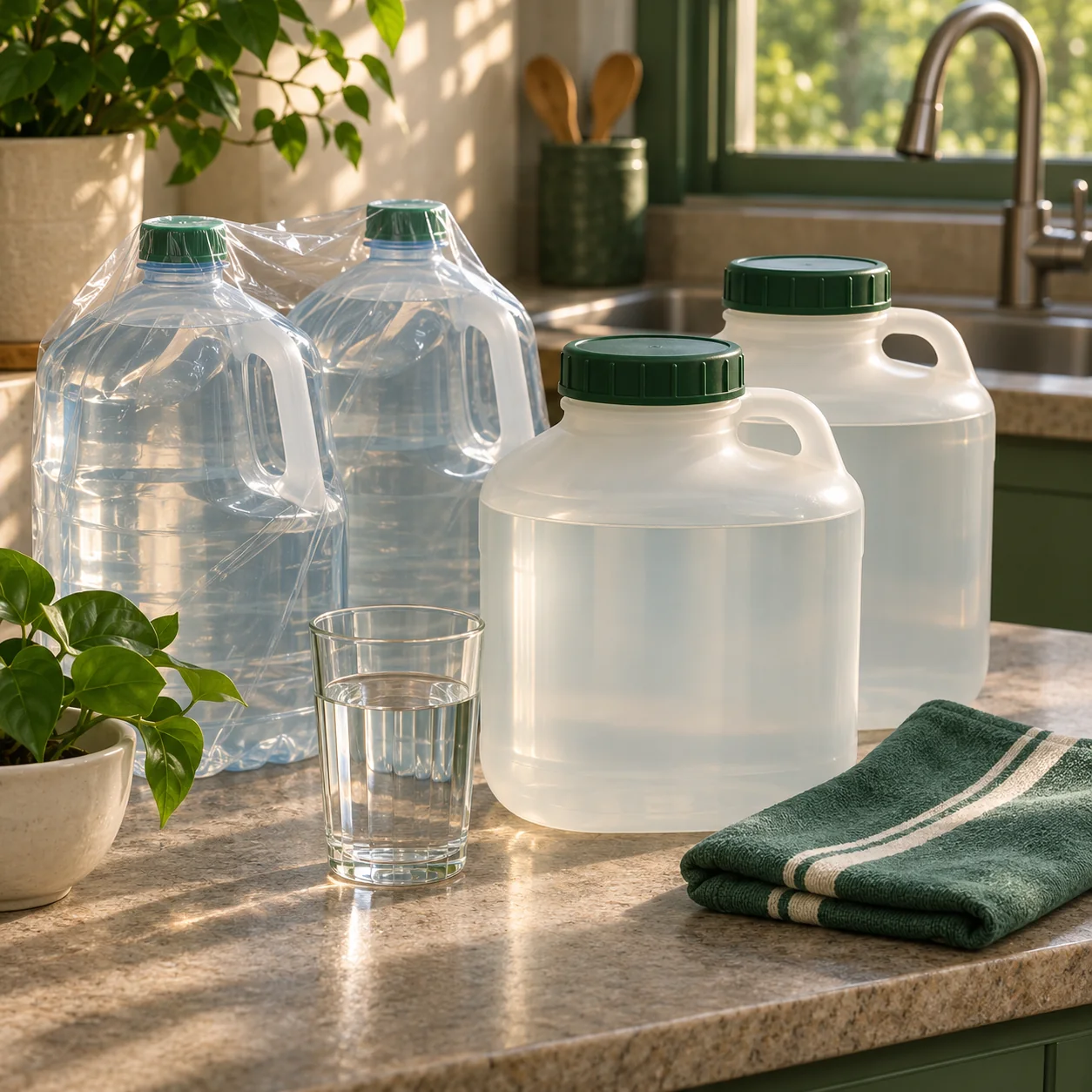
Choose durable, tightly closing food grade containers that have never held toxic chemicals. Label self filled containers with the fill date and intended purpose, and use CDC's container cleaning instructions rather than improvising a chemical mixture. Replace self filled stored water every six months and follow the date information on commercially bottled supplies. Keep containers protected from heat, sunlight, contamination, and household chemicals. Build rotation into a regular pantry check so the reserve remains a working household system instead of an abandoned stack of bottles.
Read the exact advisory before touching a filter
A boil water advisory, a do not drink advisory, and a do not use advisory are different instructions. The reason matters. A broken main may create a microbial concern; a chemical incident may require another water source entirely. Read the issuing authority's actual notice, including its instructions for cooking, teeth brushing, appliances, pets, and infant feeding. Do not rely on a neighbor's abbreviated version or a social post that omits the location and time. Save the notice and look for the official update that ends it.
During a boil water advisory, a household pitcher or refrigerator filter is not permission to skip boiling. CDC specifically says to boil even filtered tap water when that advisory applies. Other advisory types may prohibit uses that boiling cannot fix. A useful written household rule is simple: identify the advisory, identify the affected supply, and follow the issuing authority's approved alternative. The CDC overview explains these distinctions: official source ↗. Outside the United States, use the equivalent local public health and water supplier instructions.
Boiling addresses germs, not every contaminant
CDC advises bringing clear water to a rolling boil for one minute, or three minutes above 6,500 feet, approximately 1,980 metres. Cloudy water should first be allowed to settle or passed through a clean cloth, paper towel, or coffee filter, following its instructions. Let boiled water cool and store it in clean, sanitized containers with tight covers. This is a microbial treatment process. The authoritative procedure and its conditions are at official source ↗.
Boiling, ordinary disinfection, and a generic filter cannot make water contaminated with fuel, toxic chemicals, or radioactive material safe. The right next action in that situation is another approved source and public health guidance. Nor does a kettle create water when the supply has stopped. Plan the fuel or electricity, cooling time, clean storage, and accessible pouring method that treatment would require. A household that cannot safely perform those steps should prioritize a reliable stored supply and assistance rather than attempting a complicated procedure during a disruption.

Match a treatment method to a defined problem
Filtration, chemical disinfection, and ultraviolet devices work differently. Their limitations depend on the actual equipment, contaminant claims, water conditions, maintenance, and correct use. A device advertised for better taste may not address infectious organisms. A microbial claim does not establish removal of a dissolved chemical. Chemical disinfectants also do not perform equally against every organism. This article deliberately does not provide an interchangeable bleach recipe: concentration, formulation, water conditions, and official instructions matter. Use the precise current public health instructions for the product and situation.
Create a two column note for any device you own: verified uses and unverified uses. Put its manual, replacement part numbers, and certification details with that note. Include what it needs to operate, such as batteries, pressure, or consumable cartridges. If the problem is outside the verified column, switch to an approved alternative rather than assuming an additional pass through the same device will solve it. This habit is especially useful when marketing words such as survival, pure, or advanced make unlike products appear interchangeable.
Protect the clean side of the process
Once water is safe, handling becomes the next task. Keep drinking water containers closed between uses, use clean dispensing equipment, and avoid turning the supply into a communal dipping bucket. Separate containers used for untreated water from those used for drinking water. Mark them in words and with an understandable visual cue, especially where several languages are spoken. Explain the system to children, visitors, carers, and anyone joining the household temporarily. A plan that depends on an unexplained color code can fail during the first busy meal.
Run a practical water rehearsal on an ordinary day. Pour the quantity you expect to need, prepare a simple meal, and notice the water used for washing and cleanup. Do not deliberately deprive anybody of water or ignore medical advice; the exercise is an inventory check. Record the missing containers, awkward lids, and dispensing problems. Add one realistic improvement at a time. Preparedness works better when the reserve, the official advisory, and the handling routine fit together. Owning a treatment product is only one possible part of that system.
Your next useful moves
- Calculate a reserve in local units and include additional household needs.
- Use food grade containers and label self filled supplies.
- Read the exact advisory type and affected location.
- Never assume boiling fixes chemical contamination.
- Keep clean water storage separate from untreated water handling.
Water Reserve Planner gives you a small first step.
Get the free resource →Local instructions, individual needs and product specifications can change. This research edition is educational; follow current authorities and appropriate qualified professionals.
Report a correction →